
Rotted Chimney Chase: Why Chases Rot and How We Rebuild Them
What a Chimney Chase Actually Is
If your home has a gas fireplace or furnace, you probably don't have a brick chimney. You have a chimney chase — a wood-framed box that runs up the side of the house (or through the roof) to enclose the metal flue pipe. It's framed like a wall, sheathed, wrapped, and sided to match the house.
Because it's just a framed box, it's only as good as its siding, trim, flashing, and paint. And because it sticks up higher than everything around it, it takes the worst of the weather — wind-driven rain hits all four sides, and there's no overhang protecting it. In the Pacific Northwest, that's a recipe for rot if the details aren't right.
Why Chases Rot
Chimney chases don't rot because of one big leak. They rot from a dozen small failures compounding over years:
- Failed caulk at trim joints. The corner boards and trim on a chase have joints every few feet. Caulk shrinks and cracks, water gets behind the paint, and the wood starts softening from the inside.
- A bad cap. The top of the chase needs a metal cap that sheds water outward with a drip edge. Many chases were built with a flat or minimal cap — or the cap's sealant failed — so water runs down into the framing instead of off it.
- Missing or failed flashing. Where the chase meets the roof, step flashing and counter-flashing are supposed to keep water out of that joint. When flashing is missing, bent, or buried under caulk, water pours straight into the wall.
- Trim wicking water. Wood trim at the base of a chase sits in the splash zone and wicks moisture up through the end grain. The before photos on this page show exactly that — the base trim dark with water staining, paint failing, moss starting to grow.
- Nobody looks up there. Chases are high, hard to see, and easy to ignore. Small problems get years to become big ones.
The Before Photos: What to Look For
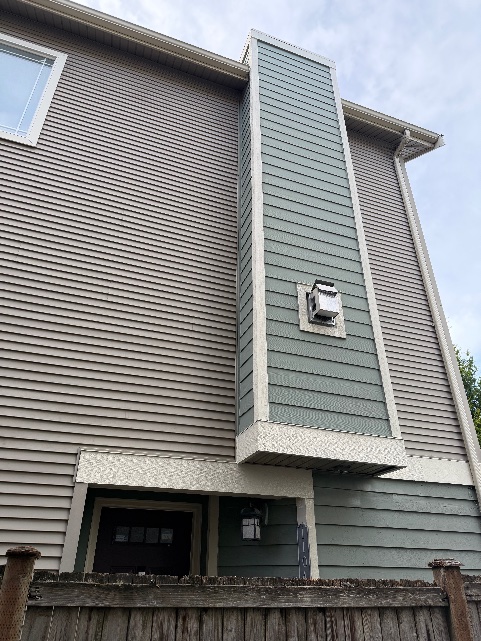
The before shots on this page are a textbook case. Look for these same signs on your own chase:
- Dark water staining running down the siding or trim — that's years of water finding a path in.
- Trim that's soft, cracked, or separating at the base and corners.
- Paint peeling high up where the chase meets the sky — paint fails first where water sits longest.
- Moss or discoloration on the trim boards.
- Gaps opening at corner boards or where trim meets siding.
Exterior view of the chimney chase before repair, showing weathering and trim degradation.
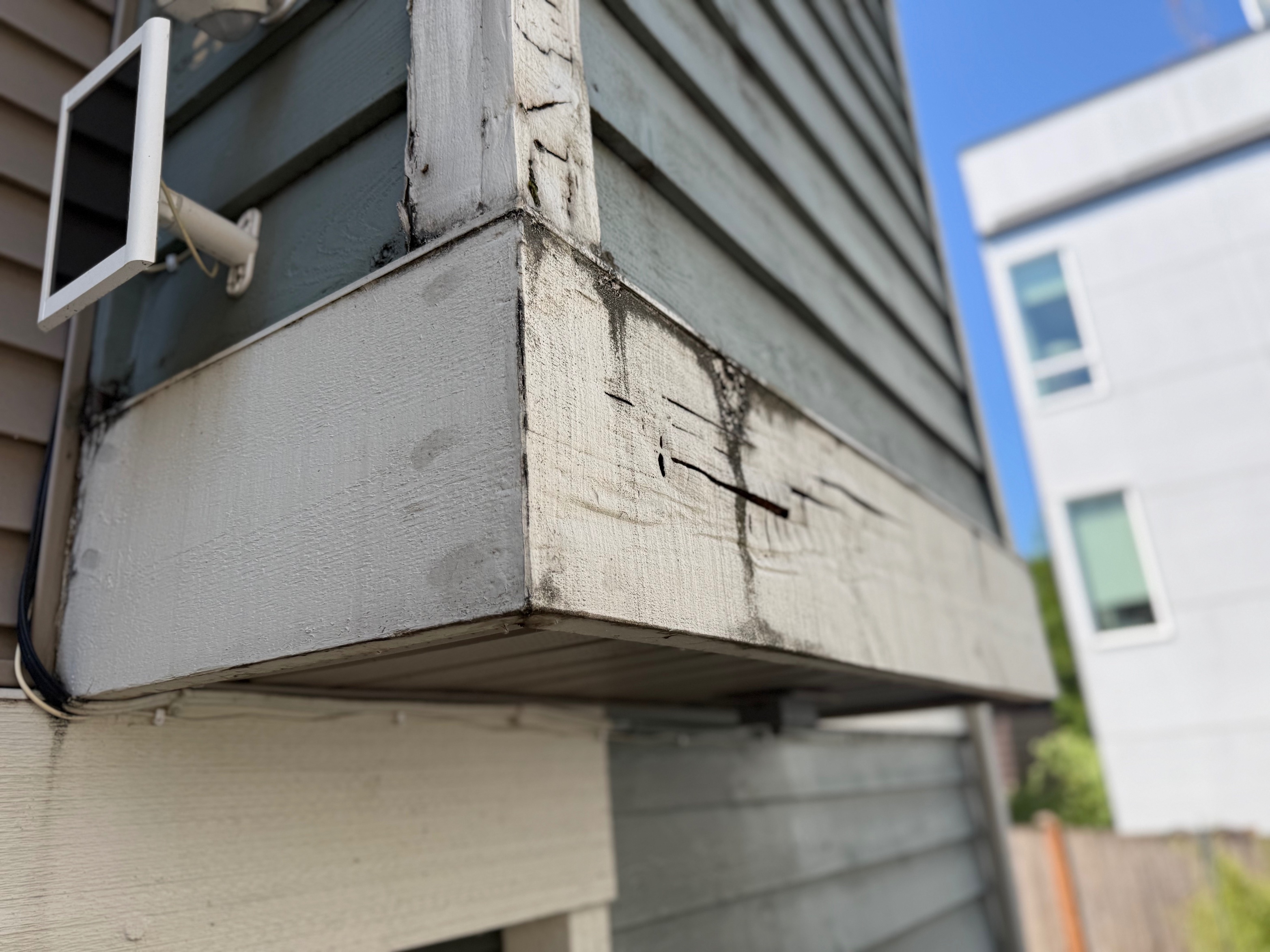
Severe water staining, split grain, and rot on the bottom trim board where water wicks up.
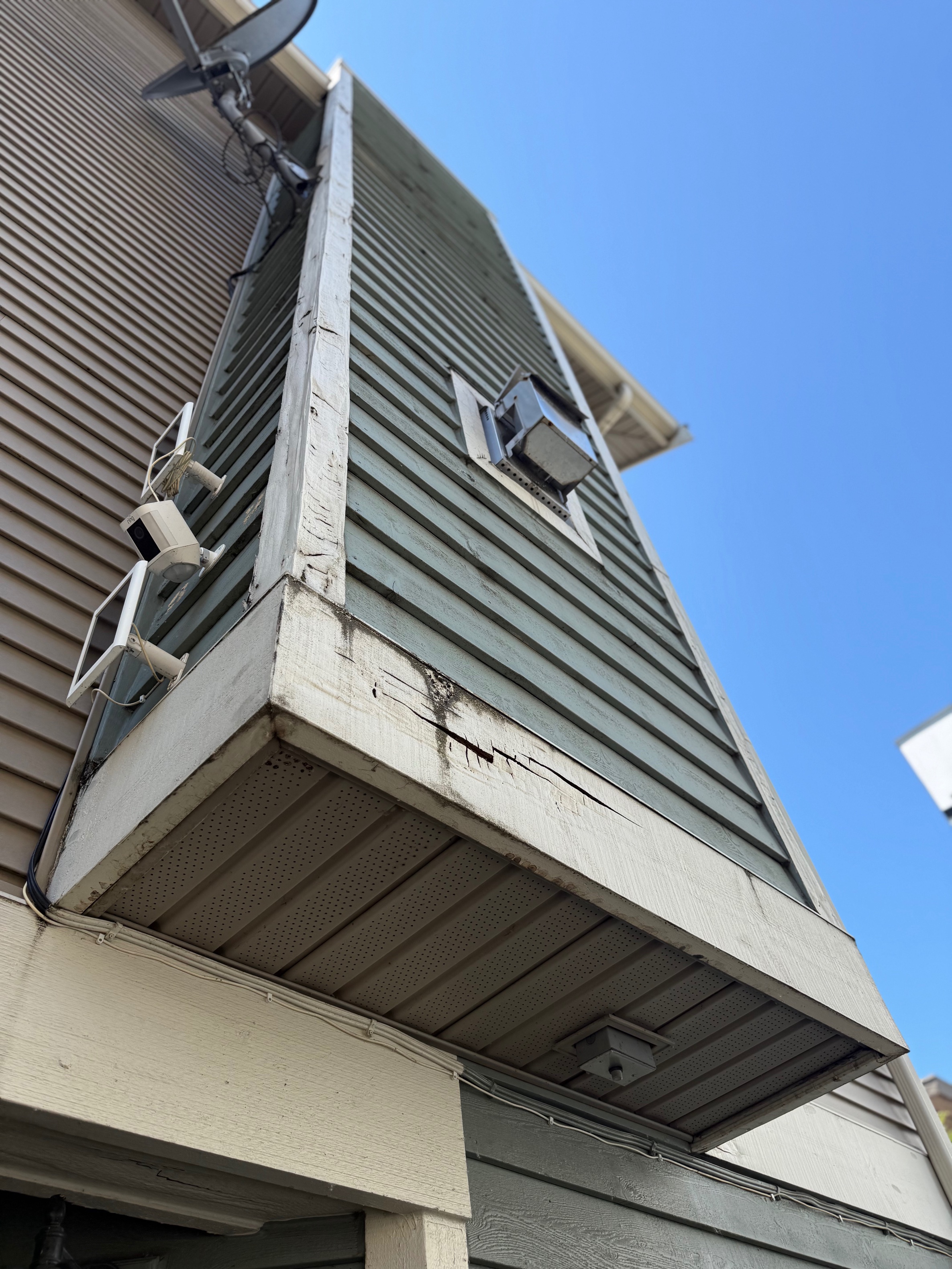
Vertical view showing corner board separation and failing paint on the upper chase.
The During Photos: Why We Open It Up
Any one of these signs means water is getting in. All of them together, like in these photos, means it's been getting in for a long time.
This is the part most homeowners never see — and the reason a chase repair is never just a re-side job.
Once we stripped the siding and trim off this chase, the framing told the real story: rotted studs, deteriorated sheathing, and water damage running through the wall. The metal flue pipe was intact, but the wood around it was not. You can't see any of that from the outside, and no amount of new siding fixes it if you don't address it.
This is why we open every rotted chase up instead of siding over it. Covering damaged framing with fresh siding hides the problem and leaves you with a chase that's structurally compromised — and a flue pipe sitting inside a rotting box, which is a safety issue, not just a cosmetic one.
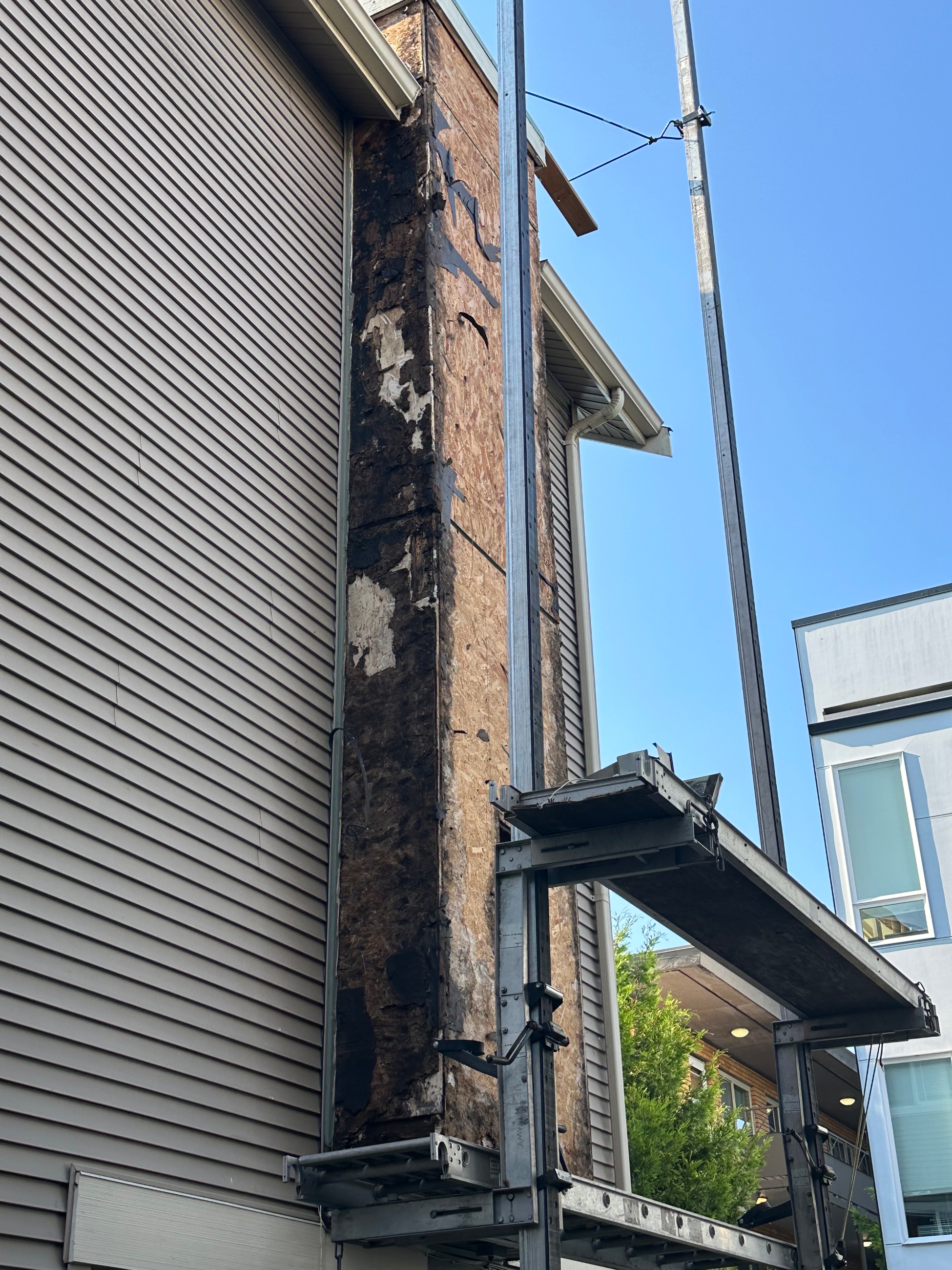
Siding removed during repair, exposing widespread black rot and water-damaged sheathing.
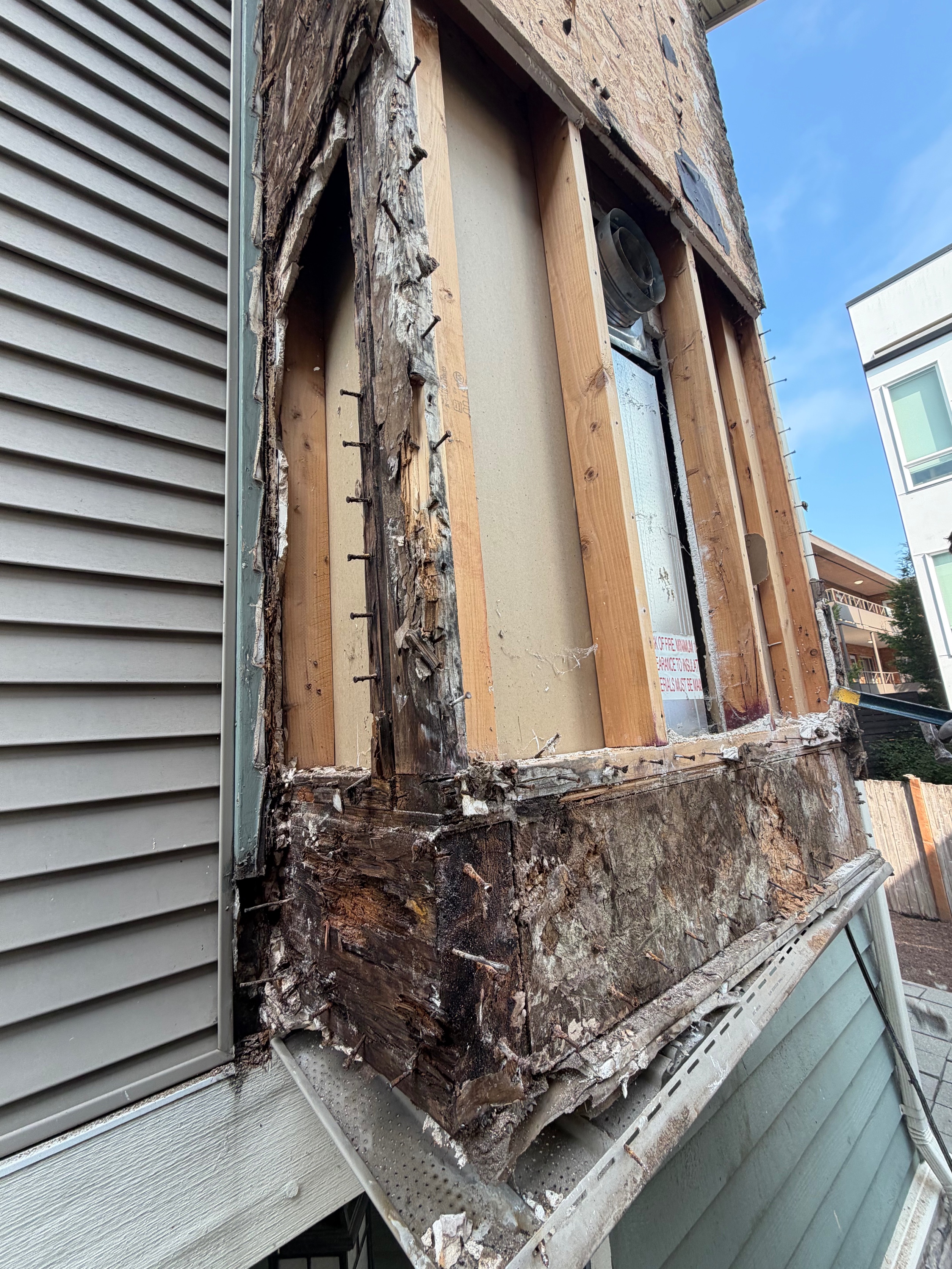
Torn open chase exposing rotted corner studs, deteriorated base framing, and the metal flue pipe.
How the Rebuild Works
- Strip it down. All the siding and trim comes off so we can see the full extent of the damage — sheathing, studs, and the wall behind.
- Replace what's rotted. Damaged studs and sheathing get cut out and replaced with new framing. We don't sister over mushy wood and hope for the best.
- Check the flue. The metal flue pipe gets inspected, and we verify proper clearances between the flue and the wood framing per code and manufacturer specs. This is a safety check, not optional.
- New weather barrier. Fresh housewrap goes on, properly lapped and taped, so any water that gets behind the siding drains down and out instead of into the wall.
- New siding. We side the chase to match the house — often James Hardie fiber cement, which won't rot and holds paint far longer than wood in this climate. The reveal and texture are matched to the existing walls.
- New trim, sealed right. Trim boards get fully primed and sealed on all sides — including every cut end — before they go up. This is the step the original build skipped.
- A proper cap. The top gets a metal cap with a drip edge that kicks water clear of the chase instead of letting it run down the sides. AHR recommends stainless steel chimney caps, as they are lifetime caps.
- Flashing at the roof. Step flashing and counter-flashing where the chase meets the roof get redone properly. This joint is one of the most common leak sources on the whole house.
- Paint to match. Full prime and topcoat, color-matched to the house, so the rebuilt chase disappears into the exterior.
Keeping It From Happening Again
A rebuilt chase lasts — but like everything on the exterior, it needs basic upkeep:
- Check the caulk every couple of years. The joints at trim and corners are the first line of defense. Re-caulk when it cracks.
- Keep the paint intact. Paint is the waterproofing. Don't let it peel, especially on the cap and trim.
- Make sure the cap is shedding water. If sealant around the cap fails, water goes straight into the framing. A quick look every year or two is enough.
- Watch the roof flashing. If you're getting roof work done, make sure the chase flashing is part of the conversation — roofers and siders both assume the other one handled it.
Frequently Asked Questions
Can't you just put new siding over the old chase?
No — and the during photos on this page are why. The framing behind rotted chase siding is often rotted too. Siding over it hides structural damage and leaves a flue pipe inside a compromised box. The chase has to be opened up.
Is the flue pipe itself usually damaged?
Usually not. Metal flue pipes hold up far better than the wood around them. We inspect it during the rebuild and verify clearances to the framing, and if the flue needs attention we'll tell you — but most of the time the pipe outlives the chase around it. When a flue does need replacing, you can usually tell right away — they begin to rust.
Do I need a roofer for this too?
The chase-to-roof flashing is part of our rebuild — we handle the chase and its flashing as one job. If your roof itself needs work beyond the flashing, we'll tell you and can coordinate, but most chase rebuilds don't require a separate roofer.
How do I know if my chase is rotted or just needs paint?
Staining, soft trim, and gaps at the joints mean water is in — that's beyond a paint job. Surface peeling with solid wood underneath is a paint issue. If you're not sure, the poke test works up there too: soft wood means rot. Or just have us look — that's what the free estimate is for.
Will my homeowner's insurance cover this?
Usually not for gradual rot — insurers generally treat long-term water damage as a maintenance issue. Sudden damage (a storm rips the cap off, for example) is a different conversation. Worth asking your insurer, but don't count on it for rot that's been developing for years.
How urgent is a rotted chase?
More urgent than it looks. The chase protects a flue pipe carrying exhaust from your fireplace or furnace, and the rot is often structural by the time it's visible. This isn't a "next spring" project — every rainy season makes it worse.
Ready to Get It Fixed?
If your chimney chase is staining, the trim is soft, or the paint is failing high up where you can't reach it, don't guess — have someone open it up and look. Call (425) 535-3425 or request your free in-home estimate. Ilya and the team at Advanced Home Repairs will inspect the chase, show you exactly what we find, and rebuild it right — framing, flashing, siding, and all.
Most homeowners don't think about their chimney chase until something looks wrong — staining running down the sides, trim that feels soft, or paint peeling way up high where nobody wants to climb. By the time a chimney chase looks bad from the ground, the damage behind it is usually worse than it appears.
We rebuild rotted chimney chases across Snohomish County, and the photos on this page show a real one: the before shots of a weathered, water-stained chase, and the during shots once we opened it up. What's behind the siding is the reason this repair can't wait.
Have Questions About Your Upcoming Project?
Tell us about your project and our team will coordinate an on-site consultation and free estimate.